[Originally written for Journalism 230 Media Reporting Class, October 2015]
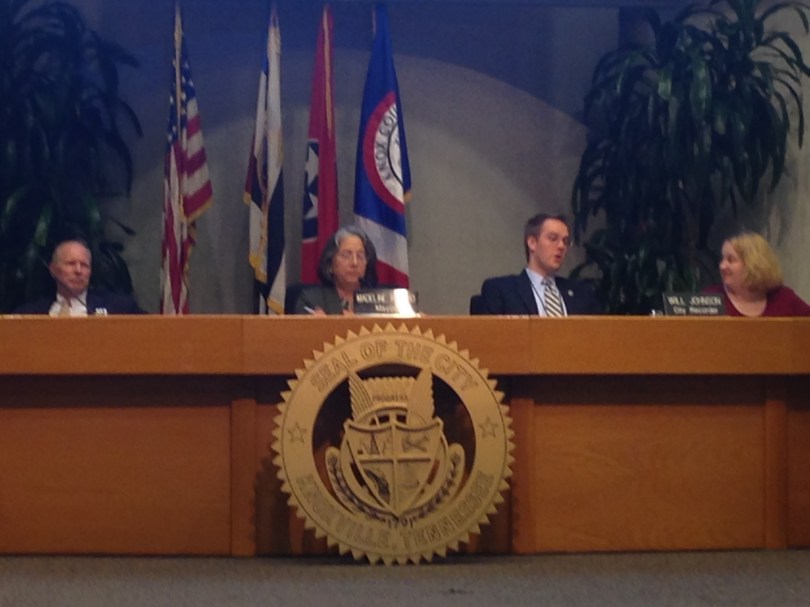
KNOXVILLE, Tenn.— “Everybody can tell you who’s running for president, some people can tell you at the state level and a lot fewer can tell you at the local level,” said Knoxville Mayor Madeline Rogero at a meeting of the Knoxville City Council on Tuesday evening. “Really, at the local level, it’s where the day in and day out quality of your life is decided in a lot of ways.”
As of Tuesday morning, only 951 votes had been cast for four of the Knoxville City Council seats. According to the U.S. Census Bureau, the population of the city of Knoxville was 183,270 people as of 2013.
George C. Wallace’s At Large Seat A term, Marshall Stair’s At Large Seat B term, Finbarr Saunders’s At Large Seat C term and Mark Campen’s Fifth District term all end in December 2015.
City Councilman Marshall Stair said that a lack of voting has become a trend in the country, especially during the past several years.
“Maybe something can change,” Stair said. “Maybe if you had a more robust campaign with greater opposition there would be more interest, but even when there’s contested races just at the council level turnout usually doesn’t exceed six or seven thousand.”
Knoxville’s decline in voter turnout reflects recent trends on the national level. Only 36.4 percent on eligible voters cast ballots in the 2014 midterm elections, according to the United States Election Project. The group says this is the smallest voter turnout in any election cycle since World War II.
Rogero said she is surprised that more people do not pay attention to local government because it provides citizens with many of the services they value and addresses local problems.
“We deal with issues about bringing jobs to town, helping businesses get started, whether you have sidewalks and bike lanes and open streets,” Rogero said. “All of those things either add jobs or create safe neighborhoods or add to the quality of life and the vibrancy of our city. That all comes down to decisions being made right here.”
According to a 2014 poll from the Census Bureau, 28 percent Americans do not vote because they are too busy to find the time. Sixteen percent said they were not interested in voting.
Stair said that this lack of participation can create a government that is not a real reflection of what the people want.
“If you have a really low turnout, whether it be a certain group [voting], they can really have a huge impact on the election,” Stair said.
Early voting ends on Thursday, Oct. 29 and Election Day is on Tuesday, Nov. 3.

 Taylor Owens