[Originally written for Journalism 230 Media Reporting Class, October 2015]
KNOXVILLE, Tenn. — “You can be an ambassador for change,” said Alice Wirth, lecturer at the University of Tennessee and director for the Diversity Student Leaders Society. “You have to have a dialogue.”
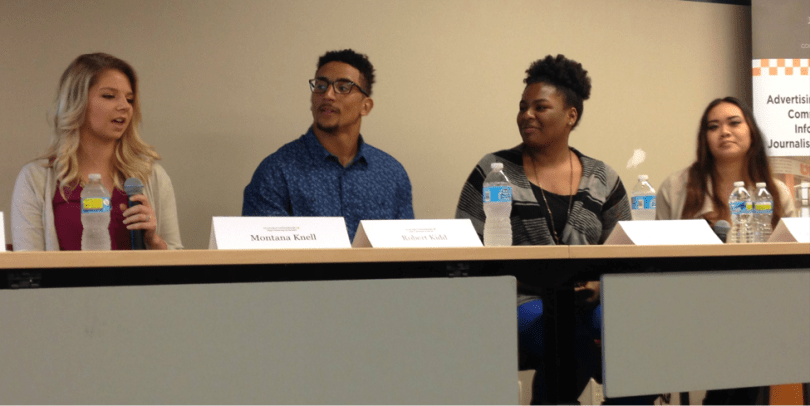
A panel of staff and students from different cultural, political and economic backgrounds attempted to educate students about the different upbringings and lifestyles of people around campus in the Diversity and Inclusion Week panel “Diversity and Inclusion: Lessons Learned from Home.” Race was an important topic for the panel because of recent tension presented in the media.
“I had a complete culture shock when I got here from Germany,” said sophomore Jakob Johnson. “People don’t look at race as much there as they do here.”
Johnson plays football for the University of Tennessee and moved to the United States for his senior year of high school. He said football was not a popular sport in Europe and he knew he would have to leave Germany if he was going to have the opportunity to play professionally.
Johnson said that it was rare to be mixed race in his home country, but people were relatively inclusive of everyone.
“I’m coming from a country where race doesn’t play much of a role to a place where I actually kind of get followed around in stores,” Johnson said.
Like Johnson, diversity student leader, Carrie Sengchanthavong, understands the struggles of growing up in a mixed race household. Sengchanthavong is Laotian, but was adopted by a Korean woman and a German man. She said race was still a difficult subject in her home.
Sengchanthavong said she witnessed the discrimination when she brought a male of another race to her home.
“I come from a very diverse community,” Sengchanthavong said. “I guess my mom didn’t really understand that I was surrounded by all of that.”
Though Johnson and Sengchanthavong come from diverse racial backgrounds, only 23 percent of the students enrolled at the University during the 2014-2015 academic year described themselves as non-white. Of the 27,410 students enrolled full-time, 21,046 were white, according to the Office of Institutional Research and Assessment.
Racism is seen differently in today’s generation than it was during the Civil Rights Movement of the 1960s. During this time period, 52 percent of all Americans saw racism as the most important issue in the country, compared to 13 percent today, according to a Gallup poll. A Music Television poll found that 72 percent of the younger generation feel they are less racist than their elders.
Courtney Boykin is also a diversity student leader. She said that something changes within a person that causes them to become an adult who discriminates against others.
“My high school was majority white and we had racist things,” Boykin said. “Sometimes people are just scared and that’s why they feel like they need to be abrasive.”
“My German grandmother is one of the most loving people I know, but she had to accept my mothering marrying a black man and having a baby with him,” Johnson added. “I feel like it’s just something you have to experience.”
Montana Knell, an administrative assistant, said that though she is not personally affected by racism, she has witnessed it in her family.
“I think it mainly comes from a place of ignorance,” Knell said. “I think in certain cases it’s at a point where it’s just too far gone.”
Nearly six in ten Americans think that race relations are generally bad, according to a New York Times and CBS News Poll.
The panelists said that people must care about others and listen to their opinions to fight this discrimination.
“A lot of us only want to hear ourselves,” Sengchanthavong said. “We don’t want to hear other points of view.”








 Taylor Owens